20. beta_stacked_barplot
20.1. Overview
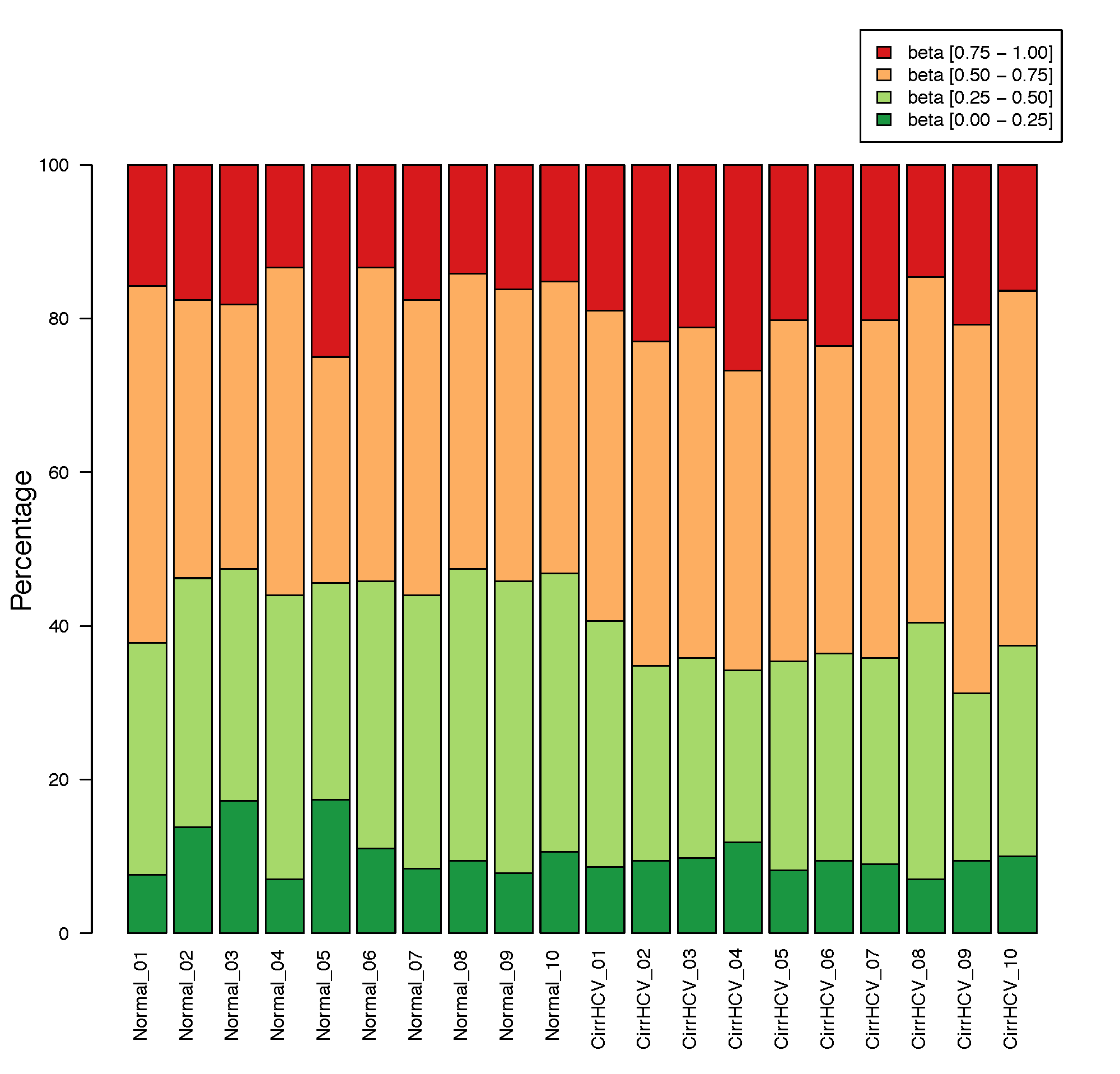
beta_stacked_barplot summarizes the distribution of Beta-values for each
sample and optionally generates a stacked bar plot.
The input matrix should have CpGs in rows and samples in columns.
Beta-values are grouped into four intervals:
[0.00, 0.25]
(0.25, 0.50]
(0.50, 0.75]
(0.75, 1.00]
20.2. Input
The input is a tabular Beta-value matrix. Delimiters are detected automatically and compressed input is supported.
Example:
CpG_ID   Sample_01   Sample_02   Sample_03   Sample_04
cg_001   0.831035    0.878022    0.794427    0.880911
cg_002   0.249544    0.209949    0.234294    0.236680
By default, finite values outside [0, 1] cause an error.
20.3. Usage
Basic usage:
beta_stacked_barplot \
    -i cirrHCV_vs_normal.data.tsv \
    -o stacked_bar
Useful options include:
--format {png,pdf,both}– plot format (default:pdf)--dpi– PNG resolution (default: 300)--widthand--height– plot size in inches--no_plot– write only the summary table--allow_out_of_range– ignore finite values outside [0, 1]
Display all options with:
beta_stacked_barplot -h
20.4. Output
For output prefix stacked_bar, the command writes:
stacked_bar.stacked_barplot.tsv– counts and percentages for each sample and Beta-value intervalstacked_bar.stacked_barplot.pdf– plot when--format pdfis usedstacked_bar.stacked_barplot.png– plot when--format pngis used
Use --format both to generate both plot formats.
20.5. Example Data
20.6. Example Figure