7. CpG_distrb_region
7.1. Overview
CpG_distrb_region summarizes CpG distribution across prioritized
user-defined genomic region classes.
One CpG BED3+ file is compared against one or more BED3+ annotation files. The order of annotation files defines their priority. Regions from lower-priority classes are merged and then have all higher-priority regions subtracted, making the final classes mutually exclusive.
For each region class, the command reports:
priority order;
region-class name;
number of non-overlapping regions;
total annotated size in base pairs;
raw CpG count; and
CpG density per kilobase.
7.2. Input Files
7.2.1. CpG file
The CpG input must be BED3 or BED3+ and contain genomic CpG positions.
Example:
chr1    10847    10848
chr1    10849    10850
chr1    15864    15865
Compressed input is supported.
7.2.2. Region files
One or more BED3+ files define the genomic region classes.
Files may be supplied as separate arguments:
-b promoters.bed enhancers.bed intergenic.bed
or as a comma-separated list for backward compatibility:
-b promoters.bed,enhancers.bed,intergenic.bed
The first BED file has the highest priority, the second has the next highest priority, and so on.
For example, if promoters.bed is listed before enhancers.bed, any
enhancer bases overlapping promoters are removed from the enhancer class.
7.3. Region Names
Use -n / --names to assign labels to the region classes.
Names may be supplied as separate arguments:
-n Promoter CpG_island Enhancer
or as a comma-separated list:
-n Promoter,CpG_island,Enhancer
The number of names must match the number of BED files, and names must be unique.
If names are omitted, the BED filenames are used as region-class names.
7.4. Usage
Basic usage:
CpG_distrb_region \
    -i 850K_probe.hg19.bed3.gz \
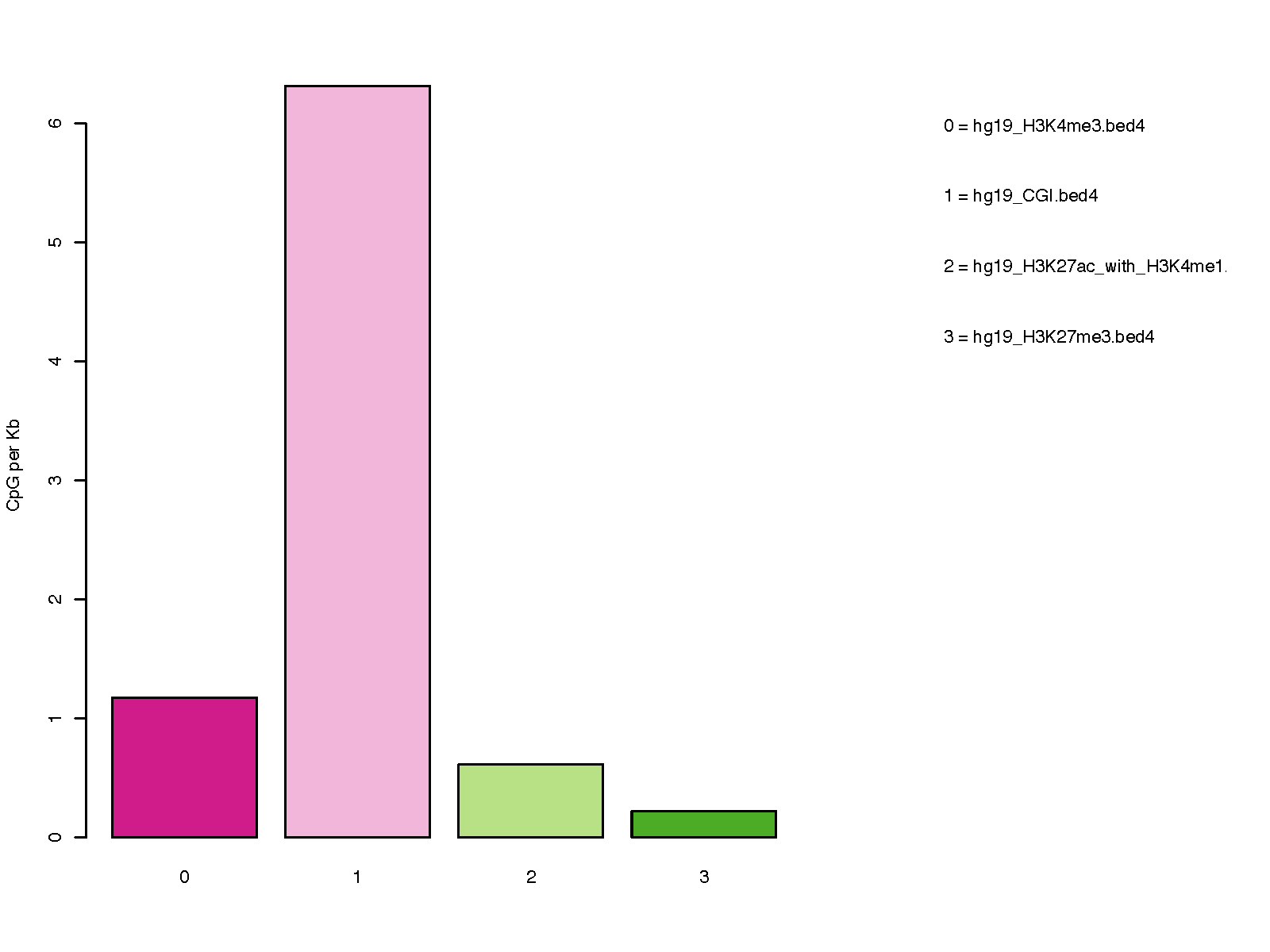
    -b hg19_H3K4me3.bed4 hg19_CGI.bed4 \
       hg19_H3K27ac_with_H3K4me1.bed4 hg19_H3K27me3.bed4 \
    -n Promoter CpG_island Bivalent_promoter Heterochromatin \
    -o regionDist
Useful options include:
-i,--cpg– CpG BED3+ input file-b,--bed– one or more BED3+ region files, ordered from highest to lowest priority-n,--names– optional region-class names--format {png,pdf,both}– plot output format (default:pdf)--dpi– PNG resolution (default: 300)--width– plot width in inches (default: 8)--height– plot height in inches (default: 6)--no_plot– write the summary table without generating a plot-o,--out_prefix,--output– output prefix
Display all options with:
CpG_distrb_region -h
7.5. Output
For output prefix regionDist, the command always writes:
regionDist.region_distribution.tsv– region-level CpG summary
The table contains:
Column |
Description |
|---|---|
|
Zero-based priority of the region class; 0 is highest priority. |
|
Region-class name. |
|
Number of non-overlapping intervals remaining after prioritization. |
|
Total size of the prioritized region class in base pairs. |
|
Number of CpGs overlapping the region class. |
|
CpG density per kilobase. |
CpG density is calculated as:
Unless --no_plot is used, the command also writes one or more plots:
regionDist.region_distribution.pdfregionDist.region_distribution.png
Use --format both to generate both plot formats.
7.6. Example Data
7.7. Example Figure